Skip to content
Lot
Seekr
Browse
Auctions
Categories
Map
Bid Center
Contact
Browse
Auctions
Categories
Map
Bid Center
Contact
More
🇬🇧
EN
EUR
DKK
SEK
NOK
GBP
PLN
CHF
CZK
USD
AUD
RON
BGN
HUF
ISK
Home
Auctions in Austria
23. Tiberius Auction - Day 3
Home
/
Auctions
/
23. Tiberius Auction - Day 3
T
Tiberius Auctions
AT
23. Tiberius Auction - Day 3
Active
26d 23h 59m
Lots
484
Location
Vienna AT
Ends
3 Dec 2026, 15:00
Currency
EUR
View Original
Pickup Location
Vienna
Lots (484)
Lots in this auction
ROSENTHAL SEATING SET, THE FOUR CARDINAL DIRECTIONS
FRANCIS SULTANA, BORN 1971
PAIR OF BARBER CHAIRS, CIRCA 1900
Verner Panton Gamtofte Parish 1926-1998 Copenhagen Pendant light Designed in 1964
TABLE LAMP, PALLME-KÖNIG MODEL
FIGURATIVE TABLE LAMP WITH GLASS SHADE, CAST BRONZE
LOUIS COMFORT TIFFANY, 1848-1933
LOUIS COMFORT TIFFANY, 1848-1933
FLORIFORM OR FROG VASE, LOUIS COMFORT TIFFANY
TIFFANY STUDIOS NYC, CIRCA 1910
GOBLET VASE, IRIDESCENT GLASS
SMALL PUMPKIN-SHAPED VASE, ORIENT & FLUME
LOW FOOTED BOWL, WMF
SMALL VASE, WMF
SMALL HANDLED VASE, WMF
SMALL GOBLET, WMF
SMALL VASE, WMF
SMALL VASE, LOETZ-WITWE KLOSTERMÜHLE
SMALL VASE, LOETZ-WITWE KLOSTERMÜHLE
SMALL VASE, LOETZ-WITWE KLOSTERMÜHLE
SMALL VASE, IN THE STYLE OF LOETZ-WITWE KLOSTERMÜHLE
JOHANN LOETZ WITWE-KLOSTERMÜHLE, HANDLED VASE
FLOWER PLANTER, ZSOLANY, PÉCS
Art Nouveau vase Daum-Nancy Layers of green and gray color, black overglaze, etched and further refined Height 10 cm, width 12 cm, opening 8 x 4.6 cm Signed on the side Jugendstilvase Daum-Nancy Grüne und graue Farbschichten, schwarzer Überfang, geätzt und nachveredelt Höhe 10 cm, Breite 12 cm, Öffnung 8 x 4,6 cm
ÉMILE GALLÉ, VASE WITH WISTERIA DECORATION
ÉMILE GALLÉ, "GLYCINE" VASE
ÉMILE GALLÉ, SMALL "CLEMATIS" VASE
ÉMILE GALLÉ, SMALL "ORCHIDÉE" VASE
ANDRÉ DELATTE, "AUX RAISINS" VASE
SPHERICAL VASE ON A FOOT, AFTER 1900
SMALL VASE WITH FLORAL DECORATION
Pedestal vase with a courtly scene 19th century? Colorless glass with ruby-red overglaze and etched decoration Height 21.3 cm Fußvase mit galanter Szene 19.
HAIDA TECHNICAL SCHOOL, DESIGNED BY MÜHLHAUS
DAGOBERT PECHE, 1887-1923
Asymmetrical vase 20th century Glass in neon yellow and smoky gray-black Height 21.5 cm, length 25.5 cm Diameter at rim 3 cm Marked “J” on the rim Asymmetrische Vase 20.
BOWL WITH PLAYING PUTTI
Ball-playing girl Made in Meissen Colorfully decorated porcelain Marked on the back near the tree stump First-grade quality Minor scuffs, slight chipping on a fold of the garment Kugelspielerin Ausführung Meißen Porzellan bunt staffiert An der
"MELONE" AUGARTEN MOCHA SET, DESIGNED BY JOSEF HOFFMANN
COFFEE & TEA SET, LILY PORCELAIN
DRUM-SHAPED STOOL, ZSOLNAY, PÉCS
ORIENTAL FEMALE BUST, DESIGNED BY GOLDSCHEIDER
WALTER BOSSE, 1904-1979
WALTER BOSSE, 1904-1979
WALL RELIEF OF A CHILD AND A SMALL BIRD, GOLDSCHEIDER
WALL MASK OF A LADY, GOLDSCHEIDER
The Flower Girl Keramos First half of the 20th century Wall relief Colorfully painted and glazed ceramic 21.5 x 18.5 cm Marked on the back Das Blumenmädchen Keramos 1. Hälfte 20.
The Wanderer (Boy with a Hat) Keramos First half of the 20th century Relief wall panel Ceramic, colorfully decorated and glazed 21.5 x 18.5 cm Marked on the back Der Wanderer (Junge mit Hut) Keramos 1. Hälfte 20.
CANDY DISH WITH FRUIT DECOR, GMUNDNER KERAMIK
MICHAEL POWOLNY, 1871-1954
PENGUIN MONEY BOX, WIENER WERKSTÄTTE
EDUARD KLABLENA, BUCANY 1881-1933 LANGENZERSDORF
ANTON KLIEBER, LITTLE DEVIL
ANTON KLIEBER, ACCORDION PLAYER
JOHANNA MEIER-MICHEL, 1876-1945
VASE WITH ELEPHANT HANDLES, ZSOLNAY, PÉCS
VASE IN THE SHAPE OF A PILGRIM’S FLASK WITH ANTIQUE SCENES AND MASCARONS
MARBLE SCULPTURE, OF A LADY
ANTIQUED BUST OF A YOUNG WOMAN, ART NOUVEAU
"JOSEPHINE BAKER" FIGURE, BASED ON A DESIGN BY KARL HAGENAUER
Josef Lorenzl 1892-1950 Dancer Bronze cast on a stone base Total height 34 cm Signed on the bronze base Josef Lorenzl 1892 - 1950 Tänzerin Bronze gegossen auf Steinsockel Gesamthöhe 34 cm
DANCER, ART DECO
DANCER, IN THE STYLE OF DEMÉTRE HARALAMB CHIPARUS
LAURITS CHRISTIAN EICHNER, 1894-1967
ART NOUVEAU BOWL BY WMF
PAIR OF BOOKENDS FEATURING A NATIVE AMERICAN CHIEF
FIGURATIVE ART NOUVEAU CANDLESTICK, CIRCA 1900
CARL AUBÖCK , VIENNA 1900-1957
CARL AUBÖCK , VIENNA 1900-1957
CARL AUBÖCK , VIENNA 1900-1957
CARL AUBÖCK , VIENNA 1900-1957
HAGENAUER WORKSHOPS, VIENNA, TENNIS PLAYER
HAGENAUER WORKSHOPS, VIENNA, GIRAFFE
HAGENAUER WORKSHOPS, VIENNA, WATERING CAN
ART NOUVEAU PLANTER, EMBOSSED BRASS
HISTORIC JARDINIÈRE CACHEPOT, CIRCA 1900, METAL
Large casket from the Wiener Werkstätte and Circle of associated items Lid and sides with relief stylized figurative decoration Metal, silver-gray patina Height 20 cm, width 35 cm Große Schatulle der Wiener Werkstätte,
ART NOUVEAU CASKET, DESIGNED BY JOSEF EMANUEL MARGOLD (1888-1962)
ELKE HUALA, BORN IN 1943 IN ST. GEORGEN NEAR MURAU
BUNDLE BY CERAMIC ARTIST ELKE HUALA, BORN IN 1943 IN ST. GEORGEN NEAR MURAU
Franz Barwig the Younger 1903-1985, attributed Mother with Child Wood carving Height 145 cm Franz Barwig der Jüngere 1903-1985,
Franz Barwig 1903-1985 Wooden relief of Mary Immaculate Carved and glazed wood 49.5 x 35 cm Signed upper left Franz Barwig 1903 - 1985 Holzrelief der Maria Immaculata Holz geschnitzt & lasiert 49,5 x 35 cm
PENDANT, WOMAN WITH A PEACOCK
POSTCARD FROM THE WIENER WERKSTÄTTE, IMPERIAL JUBILEE CELEBRATION PARADE, VIENNA, CA. 1908
WIENER WERKSTÄTTE, BUNDLE OF POSTCARDS
Prof. Maria Michna Vienna School of Applied Arts Design for the Vienna School of Applied Arts Helmet Orchid Watercolor on paper 44 x 31 cm, with frame 62 x 47 cm Signed lower center Maria Michna was active in the 1930s (including the second half of the decade) as a teacher and assistant at the Vienna School of Applied Arts (today the University of Applied Arts Vienna). She was active within the textile workshop (including in connection with Prof. Eduard Josef Wimmer-Wisgrill’s specialized class). Works from this context, including modern textile fabrics, were presented at major trade exhibitions of the time (such as the Grassimesse). Leadership and Influence of Eduard Josef Wimmer-Wisgrill During this period, the Department of Fashion, Textile Art, and Textile Design was primarily led by Prof. Eduard Josef Wimmer-Wisgrill (who was active at the institution from 1925 through the 1950s). Wimmer-Wisgrill had previously been a co-founder and director of the fashion department at the Wiener Werkstätte and shaped generations of students with his elegant style, strongly influenced by graphic and ornamental elements. Female artists such as Maria Michna worked in this specialized class as assistants or workshop leaders, overseeing practical instruction (weaving, printing, and material studies). Her colleagues included Mathilde Flögl, Hilda Jesser-Schmied, Maria Likarz-Strauss, Vally Wieselthier, and Gudrun Baudisch. In addition to her work in arts and crafts and textiles, she also emerged as a painter in the 1930s within the context of groups such as the Wiener Frauenkunst. However, apart from these mentions, her biography within an institutional framework has been preserved only in fragments. According to oral tradition, Maria Michna—aside from her artistic career—is said to have supplied the Erzherzog-Johann-Hütte (Adlersruhe), located at an altitude of 3,454 meters on the Großglockner, with food at a time when this had to be accomplished on foot under arduous conditions. Prof. Maria Michna Wiener Kunstgewerbeschule Entwurf für die Wiener Kunstgewerbeschule Helmknabenkraut
Prof. Maria Michna Vienna School of Applied Arts Design drawings for the Vienna School of Applied Arts Each in pencil on paper 18 x 15.5 cm, with frame 29.5 x 26 cm Signed lower right 18 x 16 cm, with frame 29.5 x 26 cm Signed lower right 14 x 18.5 cm, with frame 29 x 32.5 cm Signed lower right 20 x 20 cm, with frame 32 x 32 cm Estate stamp on the reverse Maria Michna was active in the 1930s (including the second half of the decade) as a teacher and assistant at the Vienna School of Applied Arts (today the University of Applied Arts Vienna). She was active within the textile workshop (including in connection with Prof. Eduard Josef Wimmer-Wisgrill’s specialized class). Works from this context, including modern textile fabrics, were presented at major trade exhibitions of the time (such as the Grassimesse). Leadership and Influence of Eduard Josef Wimmer-Wisgrill During this period, the Department of Fashion, Textile Art, and Textile Design was primarily led by Prof. Eduard Josef Wimmer-Wisgrill (who was active at the institution from 1925 through the 1950s). Wimmer-Wisgrill had previously been a co-founder and director of the fashion department at the Wiener Werkstätte and shaped generations of students with his elegant style, strongly influenced by graphic and ornamental elements. Female artists such as Maria Michna worked in this specialized class as assistants or workshop leaders, overseeing practical instruction (weaving, printing, and material studies). Her colleagues included Mathilde Flögl, Hilda Jesser-Schmied, Maria Likarz-Strauss, Vally Wieselthier, and Gudrun Baudisch. In addition to her work in arts and crafts and textiles, she also emerged as a painter in the 1930s within the context of groups such as the Wiener Frauenkunst. However, apart from these mentions, her biography within an institutional framework has been preserved only in fragments. According to oral tradition, Maria Michna—aside from her artistic career—is said to have supplied the Erzherzog-Johann-Hütte (Adlersruhe), located at 3,454 meters on the Großglockner, with food at a time when this had to be accomplished on foot under arduous conditions. Prof. Maria Michna Wiener Kunstgewerbeschule Entwurfszeichnungen für die Wiener Kunstgewerbeschule Jeweils Bleistift auf Papier 18 x 15,5 cm, mit
Prof. Maria Michna Vienna School of Applied Arts Design drawings for the Vienna School of Applied Arts Watercolor on paper 5 glove designs Each 27.5 x 22 cm, with frame 36.5 x 29 cm Signed lower center Maria Michna was active in the 1930s (including the second half of the decade) as a teacher and assistant at the Vienna School of Applied Arts (today the University of Applied Arts Vienna). She was active within the textile workshop (including in connection with Prof. Eduard Josef Wimmer-Wisgrill’s specialized class). Works from this context, including modern textile fabrics, were presented at major trade exhibitions of the time (such as the Grassimesse). Leadership and Influence of Eduard Josef Wimmer-Wisgrill During this period, the Department of Fashion, Textile Art, and Textile Design was primarily led by Prof. Eduard Josef Wimmer-Wisgrill (who was active at the institution from 1925 through the 1950s). Wimmer-Wisgrill had previously been a co-founder and director of the fashion department at the Wiener Werkstätte and shaped generations of students with his elegant style, strongly influenced by graphic and ornamental elements. Female artists such as Maria Michna worked in this specialized class as assistants or workshop leaders, overseeing practical instruction (weaving, printing, and material studies). Her colleagues included Mathilde Flögl, Hilda Jesser-Schmied, Maria Likarz-Strauss, Vally Wieselthier, and Gudrun Baudisch. In addition to her work in arts and crafts and textiles, she also emerged as a painter in the 1930s within the context of groups such as the Wiener Frauenkunst. However, apart from these mentions, her biography within an institutional framework has been preserved only in fragments. According to oral tradition, Maria Michna—aside from her artistic career—is said to have supplied the Erzherzog-Johann-Hütte (Adlersruhe), located at an altitude of 3,454 meters on the Großglockner, with food at a time when this had to be accomplished on foot under arduous conditions. Prof. Maria Michna Wiener Kunstgewerbeschule Entwurfszeichnungen für die Wiener Kunstgewerbeschule
Prof. Maria Michna Vienna School of Applied Arts Design drawings for the School of Applied Arts 4 pencil drawings on paper 1 pen-and-ink drawing with gold paint on paper 20.5 x 14.5 cm, with frame 35 x 27.5 cm Estate stamp on the reverse Pencil on paper 17.5 x 16.5 cm, with frame 31 x 27.5 cm Signed lower right Pencil on paper 14 x 14.5 cm, with frame 29 x 26 cm Signed lower right Pencil on paper 14.5 x 13.5 cm, with frame 28 x 24.5 cm Signed lower right Pencil on paper 11 x 12.5 cm, with frame 30 x 26.5 cm Signed lower right Maria Michna was active in the 1930s (including the second half of the decade) as a teacher and assistant at the Vienna School of Applied Arts (today the University of Applied Arts Vienna). She was active within the textile workshop (including in connection with Prof. Eduard Josef Wimmer-Wisgrill’s specialized class). Works from this milieu, including modern textile fabrics, were presented at major trade exhibitions of the time (such as the Grassimesse). Leadership and Influence of Eduard Josef Wimmer-Wisgrill During this period, the Department of Fashion, Textile Art, and Textile Design was primarily led by Prof. Eduard Josef Wimmer-Wisgrill (who was active at the institution from 1925 through the 1950s). Wimmer-Wisgrill had previously been a co-founder and director of the fashion department at the Wiener Werkstätte and shaped generations of students with his elegant style, strongly influenced by graphic and ornamental elements. Female artists such as Maria Michna worked in this specialized class as assistants or workshop leaders, overseeing practical instruction (weaving, printing, and material studies). Her colleagues included Mathilde Flögl, Hilda Jesser-Schmied, Maria Likarz-Strauss, Vally Wieselthier, and Gudrun Baudisch. In addition to her work in arts and crafts and textiles, she also emerged as a painter in the 1930s within the context of groups such as the Wiener Frauenkunst. However, apart from these mentions, her biography within an institutional framework has been preserved only in fragments. According to oral tradition, Maria Michna—aside from her artistic career—is said to have supplied the Erzherzog-Johann-Hütte (Adlersruhe), located at an altitude of 3,454 meters on the Großglockner, with food at a time when this had to be accomplished on foot under arduous conditions. Prof. Maria Michna Wiener Kunstgewerbeschule Entwurfszeichnungen für die Kunstgewerbeschule 4 Bleistiftzeichnungen auf Papier 1 Federzeichnung und Goldfarbe auf Papier 20,5 x 14,5 cm, mit
Prof. Maria Michna Vienna School of Applied Arts Design drawings for the Vienna School of Applied Arts 7 design drawings Mixed media on paper Each 23 x 12 cm, framed 30 x 18.5 cm Signed lower center Maria Michna was active in the 1930s (including the second half of the decade) as a teacher and assistant at the Vienna School of Applied Arts (today the University of Applied Arts Vienna). She was active within the textile workshop (including in connection with Prof. Eduard Josef Wimmer-Wisgrill’s specialized class). Works from this context, including modern textile fabrics, were presented at major trade exhibitions of the time (such as the Grassimesse). Leadership and Influence of Eduard Josef Wimmer-Wisgrill During this period, the Department of Fashion, Textile Art, and Textile Design was primarily led by Prof. Eduard Josef Wimmer-Wisgrill (who was active at the institution from 1925 through the 1950s). Wimmer-Wisgrill had previously been a co-founder and director of the fashion department at the Wiener Werkstätte and shaped generations of students with his elegant style, strongly influenced by graphic and ornamental elements. Female artists such as Maria Michna worked in this specialized class as assistants or workshop leaders, overseeing practical instruction (weaving, printing, and material studies). Her colleagues included Mathilde Flögl, Hilda Jesser-Schmied, Maria Likarz-Strauss, Vally Wieselthier, and Gudrun Baudisch. In addition to her work in arts and crafts and textiles, she also emerged as a painter in the 1930s within the context of groups such as the Wiener Frauenkunst. However, apart from these mentions, her biography within an institutional framework has been preserved only in fragments. According to oral tradition, Maria Michna—aside from her artistic career—is said to have supplied the Erzherzog-Johann-Hütte (Adlersruhe), located at an altitude of 3,454 meters on the Großglockner, with food at a time when this had to be accomplished on foot under arduous conditions. Prof. Maria Michna Wiener Kunstgewerbeschule Entwurfszeichnungen für die Wiener Kunstgewerbeschule 7 Entwurfszeichnungen Mischtechnik auf Papier Je 23 x 12 cm, mit
Prof. Maria Michna Vienna School of Applied Arts Designs for the Vienna School of Applied Arts Mixed media on paper 32 x 22 cm, with frame 41 x 31 cm 32.5 x 24.5 cm, with frame 40.5 x 32.5 cm 27 x 24 cm, with frame 44 x 39.5 cm A Broken Glass Maria Michna was active in the 1930s (including the second half of the decade) as a teacher and assistant at the Vienna School of Applied Arts (today the University of Applied Arts Vienna). She was active within the textile workshop (including in connection with Prof. Eduard Josef Wimmer-Wisgrill’s specialized class). Works from this milieu, including modern textile fabrics, were presented at major trade exhibitions of the time (such as the Grassimesse). Leadership and Influence of Eduard Josef Wimmer-Wisgrill During this period, the Department of Fashion, Textile Art, and Textile Design was primarily led by Prof. Eduard Josef Wimmer-Wisgrill (who was active at the institution from 1925 through the 1950s). Wimmer-Wisgrill had previously been a co-founder and director of the fashion department at the Wiener Werkstätte and shaped generations of students with his elegant style, strongly influenced by graphic and ornamental elements. Female artists such as Maria Michna worked in this specialized class as assistants or workshop leaders, overseeing practical instruction (weaving, printing, and material studies). Her colleagues included Mathilde Flögl, Hilda Jesser-Schmied, Maria Likarz-Strauss, Vally Wieselthier, and Gudrun Baudisch. In addition to her work in arts and crafts and textiles, she also emerged as a painter in the 1930s within the context of groups such as the Wiener Frauenkunst. However, apart from these mentions, her biography within an institutional framework has been preserved only in fragments. According to oral tradition, Maria Michna—aside from her artistic career—is said to have supplied the Erzherzog-Johann-Hütte (Adlersruhe), located at an altitude of 3,454 meters on the Großglockner, with food at a time when this had to be accomplished on foot under arduous conditions. Prof. Maria Michna Wiener Kunstgewerbeschule Entwürfe zur Wiener Kunstgewerbeschule Mischtechnik auf Papier 32 x 22 cm, mit
Prof. Maria Michna Vienna School of Applied Arts Design for the Vienna School of Applied Arts Mixed media on paper 75 x 51 cm, 85 x 63 cm with frame Maria Michna was active in the 1930s (particularly in the second half of the decade) as a teacher and assistant at the Vienna School of Applied Arts (today the University of Applied Arts Vienna). She worked in the textile workshop (including in connection with Prof. Eduard Josef Wimmer-Wisgrill’s specialized class). Works from this milieu, including modern textiles, were presented at major trade exhibitions of the time (such as the Grassimesse). Leadership and Influence of Eduard Josef Wimmer-Wisgrill During this period, the Department of Fashion, Textile Art, and Textile Design was primarily led by Prof. Eduard Josef Wimmer-Wisgrill (who worked at the institution from 1925 through the 1950s). Wimmer-Wisgrill had previously been a co-founder and director of the fashion department at the Wiener Werkstätte and shaped generations of students with his elegant style, strongly influenced by graphic and ornamental elements. Female artists such as Maria Michna worked in this specialized class as assistants or workshop leaders, overseeing practical instruction (weaving, printing, and material studies). Her colleagues included Mathilde Flögl, Hilda Jesser-Schmied, Maria Likarz-Strauss, Vally Wieselthier, and Gudrun Baudisch. In addition to her work in arts and crafts and textiles, she also emerged as a painter in the 1930s within the context of groups such as Wiener Frauenkunst. However, apart from these mentions, her biography within an institutional framework has been preserved only in fragments. According to oral tradition, Maria Michna—aside from her artistic career—is said to have supplied the Erzherzog-Johann-Hütte (Adlersruhe), located at 3,454 meters on the Großglockner, with food at a time when this had to be accomplished on foot under arduous conditions. Prof. Maria Michna Wiener Kunstgewerbeschule Entwurf für die Wiener Kunstgewerbeschule Mischtechnik auf Papier 75 x 51 cm, mit
Prof. Maria Michna Vienna School of Applied Arts Design for the Vienna School of Applied Arts Flower Still Life Mixed media on paper Lower right: Estate stamp? 68 x 56 cm, with frame 90 x 82 cm Maria Michna was active in the 1930s (including the second half of the decade) as a teacher and assistant at the Vienna School of Applied Arts (today the University of Applied Arts Vienna). She was active within the textile workshop (including in connection with Prof. Eduard Josef Wimmer-Wisgrill’s specialized class). Works from this context, including modern textile fabrics, were presented at major trade exhibitions (such as the Grassimesse) at the time. Leadership and Influence of Eduard Josef Wimmer-Wisgrill During this period, the Department of Fashion, Textile Art, and Textile Design was primarily led by Prof. Eduard Josef Wimmer-Wisgrill (who was active at the institution from 1925 through the 1950s). Wimmer-Wisgrill had previously been a co-founder and director of the fashion department at the Wiener Werkstätte and shaped generations of students with his elegant style, strongly influenced by graphic and ornamental elements. Female artists such as Maria Michna worked in this specialized class as assistants or workshop leaders, overseeing practical instruction (weaving, printing, and material studies). Her colleagues included Mathilde Flögl, Hilda Jesser-Schmied, Maria Likarz-Strauss, Vally Wieselthier, and Gudrun Baudisch. In addition to her work in arts and crafts and textiles, she also emerged as a painter in the 1930s within the context of groups such as the Wiener Frauenkunst. However, apart from these mentions, her biography within an institutional framework has been preserved only in fragments. According to oral tradition, Maria Michna—aside from her artistic career—is said to have supplied the Erzherzog-Johann-Hütte (Adlersruhe), located at an altitude of 3,454 meters on the Großglockner, with food at a time when this had to be accomplished on foot under arduous conditions. Prof. Maria Michna Wiener Kunstgewerbeschule Entwurf für die Wiener Kunstgewerbeschule Blumenstillleben Mischtechnik auf Papier Rechts unten Nachlassstempel? 68 x 56 cm, mit
Prof. Maria Michna Vienna School of Applied Arts Design for the Vienna School of Applied Arts Mixed media on paper 75 x 47 cm, with frame 83 x 58 cm Maria Michna was active in the 1930s (including the second half of the decade) as a teacher and assistant at the Vienna School of Applied Arts (today the University of Applied Arts Vienna). She was involved with the textile workshop (including in connection with the specialized class taught by Prof. Eduard Josef Wimmer-Wisgrill). Works from this milieu, including modern textile fabrics, were presented at major trade exhibitions of the time (such as the Grassimesse). Leadership and Influence of Eduard Josef Wimmer-Wisgrill During this period, the Department of Fashion, Textile Art, and Textile Design was primarily led by Prof. Eduard Josef Wimmer-Wisgrill (who worked at the institution from 1925 through the 1950s). Wimmer-Wisgrill had previously been a co-founder and director of the fashion department at the Wiener Werkstätte and shaped generations of students with his elegant style, strongly influenced by graphic and ornamental elements. Female artists such as Maria Michna worked in this specialized class as assistants or workshop leaders, overseeing practical instruction (weaving, printing, and material studies). Her colleagues included Mathilde Flögl, Hilda Jesser-Schmied, Maria Likarz-Strauss, Vally Wieselthier, and Gudrun Baudisch. In addition to her work in arts and crafts and textiles, she also emerged as a painter in the 1930s within the context of groups such as the Wiener Frauenkunst. However, apart from these mentions, her biography within an institutional framework has been preserved only in fragments. According to oral tradition, Maria Michna—aside from her artistic career—is said to have supplied the Erzherzog-Johann-Hütte (Adlersruhe), located at an altitude of 3,454 meters on the Großglockner, with food at a time when this had to be accomplished on foot under arduous conditions. Prof. Maria Michna Wiener Kunstgewerbeschule Entwurf für die Wiener Kunstgewerbeschule Mischtechnik auf Papier 75 x 47 cm, mit
Prof. Maria Michna Vienna School of Applied Arts Design for the Vienna School of Applied Arts Mixed media on paper 50 x 50 cm, 65 x 65 cm with frame Maria Michna was active in the 1930s (including the second half of the decade) as a teacher and assistant at the Vienna School of Applied Arts (today the University of Applied Arts Vienna). She was involved with the textile workshop (including in connection with the specialized class taught by Prof. Eduard Josef Wimmer-Wisgrill). Works from this milieu, including modern textiles, were presented at major trade exhibitions of the time (such as the Grassimesse). Leadership and Influence of Eduard Josef Wimmer-Wisgrill During this period, the Department of Fashion, Textile Art, and Textile Design was primarily led by Prof. Eduard Josef Wimmer-Wisgrill (who was active at the institution from 1925 through the 1950s). Wimmer-Wisgrill had previously been a co-founder and director of the fashion department at the Wiener Werkstätte and shaped generations of students with his elegant style, strongly influenced by graphic and ornamental elements. Female artists such as Maria Michna worked in this specialized class as assistants or workshop leaders, overseeing practical instruction (weaving, printing, and material studies). Her colleagues included Mathilde Flögl, Hilda Jesser-Schmied, Maria Likarz-Strauss, Vally Wieselthier, and Gudrun Baudisch. In addition to her work in arts and crafts and textiles, she also emerged as a painter in the 1930s within the context of groups such as Wiener Frauenkunst. However, apart from these mentions, her biography within an institutional framework has been preserved only in fragments. According to oral tradition, Maria Michna—aside from her artistic career—is said to have supplied the Erzherzog-Johann-Hütte (Adlersruhe), located at an altitude of 3,454 meters on the Großglockner, with food at a time when this had to be accomplished on foot under arduous conditions. Prof. Maria Michna Wiener Kunstgewerbeschule Entwurf für die Wiener Kunstgewerbeschule Mischtechnik auf Papier 50 x 50 cm, mit
Prof. Maria Michna Vienna School of Applied Arts Design for the Vienna School of Applied Arts Mixed media on paper 23.5 x 21.5 cm, with frame 60 x 55.5 cm Signed lower center Maria Michna was active in the 1930s (including the second half of the decade) as a teacher and assistant at the Vienna School of Applied Arts (today the University of Applied Arts Vienna). She was active within the textile workshop (including in connection with Prof. Eduard Josef Wimmer-Wisgrill’s specialized class). Works from this context, including modern textile fabrics, were presented at major trade exhibitions of the time (such as the Grassimesse). Leadership and Influence of Eduard Josef Wimmer-Wisgrill During this period, the Department of Fashion, Textile Art, and Textile Design was primarily led by Prof. Eduard Josef Wimmer-Wisgrill (who was active at the institution from 1925 through the 1950s). Wimmer-Wisgrill had previously been a co-founder and director of the fashion department at the Wiener Werkstätte and shaped generations of students with his elegant style, strongly influenced by graphic and ornamental elements. Female artists such as Maria Michna worked in this specialized class as assistants or workshop leaders, overseeing practical instruction (weaving, printing, and material studies). Her colleagues included Mathilde Flögl, Hilda Jesser-Schmied, Maria Likarz-Strauss, Vally Wieselthier, and Gudrun Baudisch. In addition to her work in arts and crafts and textiles, she also emerged as a painter in the 1930s within the context of groups such as the Wiener Frauenkunst. However, apart from these mentions, her biography within an institutional framework has been preserved only in fragments. According to oral tradition, Maria Michna—aside from her artistic career—is said to have supplied the Erzherzog-Johann-Hütte (Adlersruhe), located at an altitude of 3,454 meters on the Großglockner, with food at a time when this had to be accomplished on foot under arduous conditions. Prof. Maria Michna Wiener Kunstgewerbeschule Entwurf für die Wiener Kunstgewerbeschule Mischtechnik auf Papier 23,5 x 21,5 cm, mit
Prof. Maria Michna Vienna School of Applied Arts Design for the Vienna School of Applied Arts Mixed media on paper 44 x 43.5 cm, with frame 52.4 x 52.5 cm Signed lower right Maria Michna was active in the 1930s (including the second half of the decade) as a teacher and assistant at the Vienna School of Applied Arts (today the University of Applied Arts Vienna). She was active within the textile workshop (including in connection with Prof. Eduard Josef Wimmer-Wisgrill’s specialized class). Works from this context, including modern textile fabrics, were presented at major trade exhibitions of the time (such as the Grassimesse). Leadership and Influence of Eduard Josef Wimmer-Wisgrill During this period, the Department of Fashion, Textile Art, and Textile Design was primarily led by Prof. Eduard Josef Wimmer-Wisgrill (who was active at the institution from 1925 through the 1950s). Wimmer-Wisgrill had previously been a co-founder and director of the fashion department at the Wiener Werkstätte and shaped generations of students with his elegant style, strongly influenced by graphic and ornamental elements. Female artists such as Maria Michna worked in this specialized class as assistants or workshop leaders, overseeing practical instruction (weaving, printing, and material studies). Her colleagues included Mathilde Flögl, Hilda Jesser-Schmied, Maria Likarz-Strauss, Vally Wieselthier, and Gudrun Baudisch. In addition to her work in arts and crafts and textiles, she also emerged as a painter in the 1930s within the context of groups such as the Wiener Frauenkunst. However, apart from these mentions, her biography within an institutional framework has been preserved only in fragments. According to oral tradition, Maria Michna—aside from her artistic career—is said to have supplied the Erzherzog-Johann-Hütte (Adlersruhe), located at an altitude of 3,454 meters on the Großglockner, with food at a time when this had to be accomplished on foot under arduous conditions. Prof. Maria Michna Wiener Kunstgewerbeschule Entwurf für die Wiener Kunstgewerbeschule Mischtechnik auf Papier 44 x 43,5 cm, mit
Prof. Maria Michna Vienna School of Applied Arts Design for the Vienna School of Applied Arts Mixed media on paper 39 x 42 cm, with frame 52 x 51.5 cm Maria Michna was active in the 1930s (including the second half of the decade) as a teacher and assistant at the Vienna School of Applied Arts (today the University of Applied Arts Vienna). She was involved with the textile workshop (including in connection with the specialized class taught by Prof. Eduard Josef Wimmer-Wisgrill). Works from this milieu, including modern textile fabrics, were presented at major trade exhibitions (such as the Grassimesse) at the time. Leadership and Influence of Eduard Josef Wimmer-Wisgrill During this period, the Department of Fashion, Textile Art, and Textile Design was primarily led by Prof. Eduard Josef Wimmer-Wisgrill (who worked at the institution from 1925 through the 1950s). Wimmer-Wisgrill had previously been a co-founder and director of the fashion department at the Wiener Werkstätte and shaped generations of students with his elegant style, strongly influenced by graphic and ornamental elements. Female artists such as Maria Michna worked in this specialized class as assistants or workshop leaders, overseeing practical instruction (weaving, printing, and material studies). Her colleagues included Mathilde Flögl, Hilda Jesser-Schmied, Maria Likarz-Strauss, Vally Wieselthier, and Gudrun Baudisch. In addition to her work in arts and crafts and textiles, she also emerged as a painter in the 1930s within the context of groups such as the Wiener Frauenkunst. However, apart from these mentions, her biography within an institutional framework has been preserved only in fragments. According to oral tradition, Maria Michna—aside from her artistic career—is said to have supplied the Erzherzog-Johann-Hütte (Adlersruhe), located at an altitude of 3,454 meters on the Großglockner, with food at a time when this had to be accomplished on foot under arduous conditions. Prof. Maria Michna Wiener Kunstgewerbeschule Entwurf für die Wiener Kunstgewerbeschule Mischtechnik auf Papier 39 x 42 cm, mit
Prof. Maria Michna Vienna School of Applied Arts Designs for the Vienna School of Applied Arts Four pieces of hand-made bobbin lace featuring floral and leaf motifs 17 x 17 cm, with frame 31.5 x 29.5 cm 22.5 x 14 cm, with frame 33 x 24.5 cm 20 x 17.5 cm, with frame 30.5 x 27.5 cm 32.5 x 21.5 cm, with frame 41.5 x 32 cm Maria Michna was active in the 1930s (including the second half of the decade) as a teacher and assistant at the Vienna School of Applied Arts (now the University of Applied Arts Vienna). She worked in the textile workshop (including in connection with Prof. Eduard Josef Wimmer-Wisgrill’s specialized class). Works from this milieu, including modern textile fabrics, were presented at major trade exhibitions of the time (such as the Grassimesse). Leadership and Influence of Eduard Josef Wimmer-Wisgrill During this period, the Department of Fashion, Textile Art, and Textile Design was primarily led by Prof. Eduard Josef Wimmer-Wisgrill (who was active at the institution from 1925 through the 1950s). Wimmer-Wisgrill had previously been a co-founder and director of the fashion department at the Wiener Werkstätte and shaped generations of students with his elegant style, strongly influenced by graphic and ornamental elements. Female artists such as Maria Michna worked in this specialized class as assistants or workshop leaders, overseeing practical instruction (weaving, printing, and material studies). Her colleagues included Mathilde Flögl, Hilda Jesser-Schmied, Maria Likarz-Strauss, Vally Wieselthier, and Gudrun Baudisch. In addition to her work in arts and crafts and textiles, she also emerged as a painter in the 1930s within the context of groups such as the Wiener Frauenkunst. However, apart from these mentions, her biography within an institutional framework has been preserved only in fragments. According to oral tradition, Maria Michna—aside from her artistic career—is said to have supplied the Erzherzog-Johann-Hütte (Adlersruhe), located at an altitude of 3,454 meters on the Großglockner, with food at a time when this had to be accomplished on foot under arduous conditions. Prof. Maria Michna Wiener Kunstgewerbeschule Entwürfe für die Wiener Kunstgewerbeschule Vier Spitzenarbeiten handgeklöppelt mit Blumen- und Blattmotiven 17 x 17 cm, mit
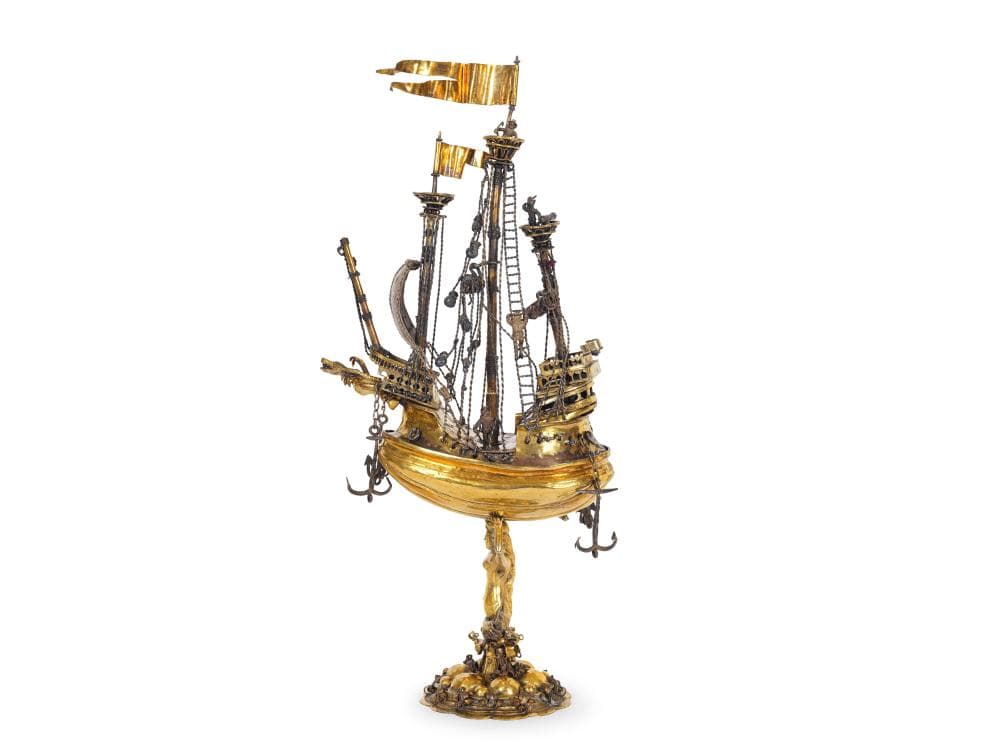
A NEW MUSEUM DISCOVERY, DRINKING VESSEL ‘NEF’
BESAMIM TOWER, AROUND 1900
Old design (v1)
Back to new
 Vienna AT